
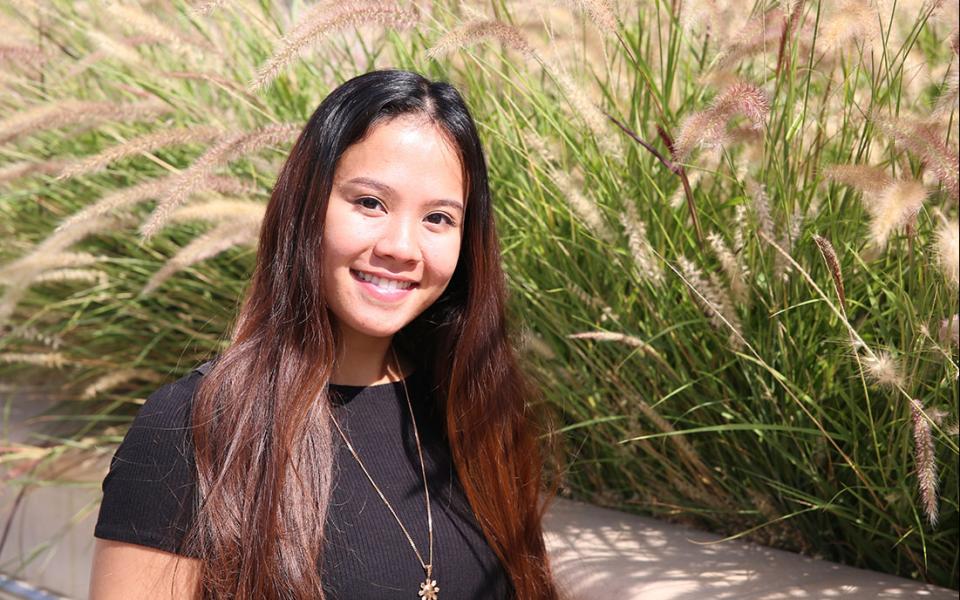
As more salt water washes into their habitats, plants either adapt or get squeezed out by the competition. If species seem fated to get squeezed out, humans can intervene by moving the plants further inland, away from the rising tides that threaten their productivity. To investigate which might need rescuing, Bonto traveled to where the marshes of Mississippi meet the Gulf Coast, a hotbed of coastal plants that provide homes to wildlife and protect people from flooding and erosion.
“I thought it would be a good idea to focus on this area of wetlands, which people don’t normally pay attention to because they’re seen as swamps,” Bonto said. But people should: “They’re essentially the barrier that protects us from the impact of sea level rise.”
Bonto focused on four islands within the Grand Bay National Estuarine Research Reserve, chosen for their differing salinity levels, treatments (two islands had been burned), and plant species, including juncus roemerianus (a.k.a. black rush), a flowering plant dominant in the brackish waters; spartina alterniflora (smooth cordgrass), dominant in the salt marshes; and spartina patens (salt hay grass), an important food source for birds. The plants were transplanted around the reserve in order to study how they respond to different conditions.
For three days last October, Bonto hopped aboard a boat and skimmed the calm marsh waters to collect data from the islands. The lush pockets of green, soaking in the Southern waters and brimming with wildlife, were a world away from the cities that Bonto has called home. Bonto, a recipient of the Whittier Fellowship for Underrepresented Students in the Sciences, brought her data back to Whittier for analysis, with guidance from her mentor Professor of Biology Cheryl Swift.
“I love working with her,” Bonto said. “She’s a great professor and very passionate.”
Bonto shared initial findings of her research at Whittier’s annual undergraduate conference. She continued her work over the summer, conducting similar research on trees in coastal Louisiana, near New Orleans. Since the area is only about a two-hour drive from the Grand Bay reserve, she returned to Mississippi to conduct further research.
Beyond Whittier, Bonto plans to earn a Ph.D. and become an environmental sciences research professor.