
Carlos Campos-Moya ’17 and Destiny Murillo ’17 never had to leave Whittier to see millions of years into the past.
The physics majors collected data from three telescopes to study supernovae, the explosive deaths some stars experience when their cores collapse, to understand more about the stars before they detonated. Using data from multiple orbiting telescopes, many of the stars were about 130 mega light years from Earth—meaning they were so far away, it took about 130 million years for their dying light to reach our telescopes.
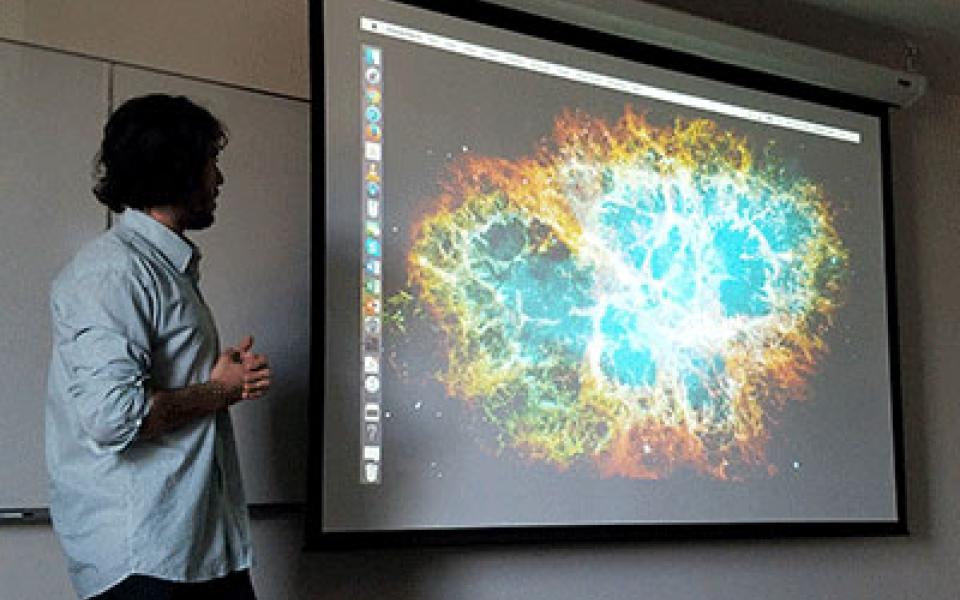
“These stars are often very, very far away,” Campos-Moya explained. Standing before a captivated audience in the Science & Learning Center during the annual undergraduate research presentation day, he pointed to a dark screen dotted with specks of light. Each represented a source of light outside the Milky Way Galaxy, some of them distant galaxies that have stars that expired with a bang. “These stars are hidden. It is only through a supernova that we can see them.”
Campos-Moya studied these distant explosions with data from the Chandra X-Ray Telescope and XMM-Newton Telescope. Murillo—who worked on the project as a junior, a year before Campos-Moya—analyzed data from the Swift X-Ray Telescope. The information they collected helped provide a picture of what’s called the circumstellar medium, the matter that emanates from a star during its life. Both were recipients of the Whittier Fellowship for Underrepresented Students in the Sciences and conducted their research with the mentorship of Visiting Professor of Physics Brock Russell.
After taking a year off, Campos-Moya plans on pursuing a graduate degree in astronomy. Murillo hopes to teach middle school math or science upon earning a master’s degree and teaching credential.