
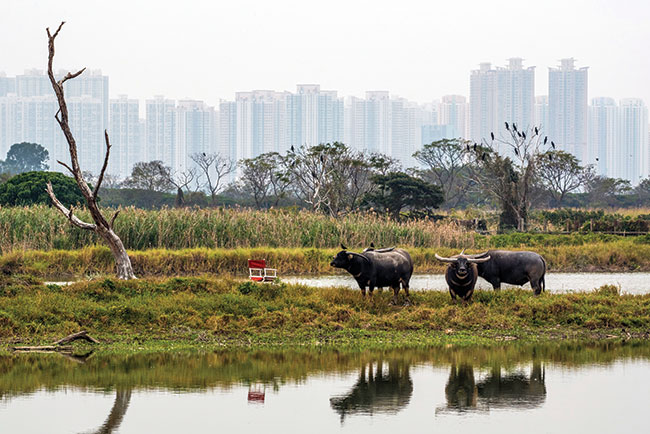
Spencer VanDerStarren ’20 looked through his long camera lens and saw water buffalo grazing in the shallow waters and tall, marshy grasses.
The animals had been rescued after roads and cities overtook their natural habitats; the wetland of the Mai Po Nature Reserve is now their lush sanctuary. VanDerStarren could see another sight through his camera lens, as one of the buffalo turned its horned head to look straight at him: the looming skyline of Shenzhen, an ever-present reminder of urbanization surrounding the reserve on almost all sides. He snapped the photo.
“We love the symbolism of the Mai Po water buffalo,” said VanDerStarren, an enormous version of the photograph behind him, as he presented the ambitious photography project, Take Your Seat, at the Luce Initiative on Asian Studies and the Environment (LIASE) conference in Villalobos Hall earlier this year. The photo features another conspicuous element: a red movie director’s chair, just off to the side. The chair is a fixture of the project; when VanDerStarren and his father travel, they capture photos of the chair in beautiful and poignant locales. The chair symbolizes the viewer and encourages them to treat the world and themselves with respect, and live the life they intended.
It was at the LIASE conference the previous year that VanDerStarren met the reserve’s wetland preservation director, Michael Lau, who came to present research. That connection led directly to Lau offering his service as Take Your Seat’s personal guide through Mai Po.
“It’s really very exciting to see this kind of connection here bear fruit in activities in China,” said the C. Milo Connick Chair of Religious Studies Professor Jason Carbine, the director of the LIASE Project.
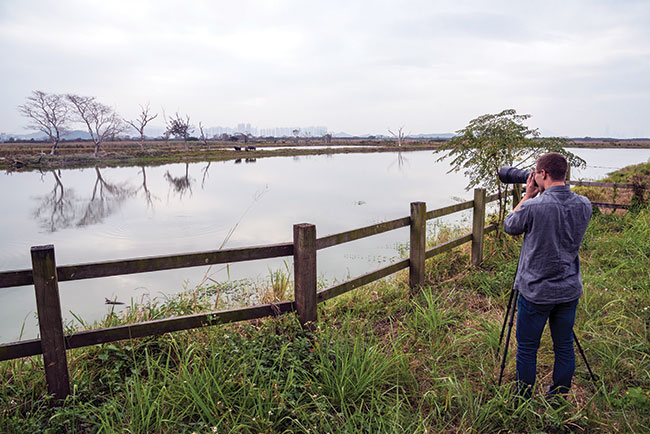
VanDerStarren, who’s working on a self-designed major in Sustainable International Business through the Whittier Scholars Program, doesn’t just want to capture beautiful scenery—though he has an immense and growing skill with his camera. He wants to highlight the intersection of man’s world with the natural one.
At the conference, he changed slides from the water buffalo to a breathtaking view of an island cliff plunging into the waves off Hong Kong. The slides changed again, this time revealing a sea of discarded plastic that had washed up on the shore.
“It breaks my heart and in some ways, I hope it breaks yours, too,” VanDerStarren said to the audience. “I hope that these snapshots combined with the Take Your Seat photographs inspire you to recognize that you only get one life and we only have this one planet.”
His studies at Whittier have certainly helped him with Take Your Seat, especially from an environmental science perspective, and he isn’t done, yet. VanDerStarren continued the project while he studied abroad in Japan this fall. Eventually, he also has plans to return to his home country, Canada, to retrace the steps of famous painters and photograph his red chair in the locations that inspired the artists to paint their renowned landscapes.
“After that, who knows? It’s a big world,” he said.